Why ChatGPT Traffic Converts 3x Better Than Traditional Search
Marketers have been obsessed with search traffic for two decades. Rank on page one, grab the click, cross your fingers, hope for conversions. That was the formula.
Now? Something shifted.
Traffic coming from ChatGPT converts - in many cases - three times better than traditional search. Not slightly better. Not marginally improved. Dramatically better.
Sounds exaggerated? It isn’t.
Businesses quietly tracking referral data are seeing a clear pattern: visitors who arrive through AI-driven recommendations behave differently. They stay longer. They trust faster. They buy sooner.
Here’s why that’s happening - and why smart brands are already adapting.
The Intent Gap: Why Traditional Search Leaks Conversions
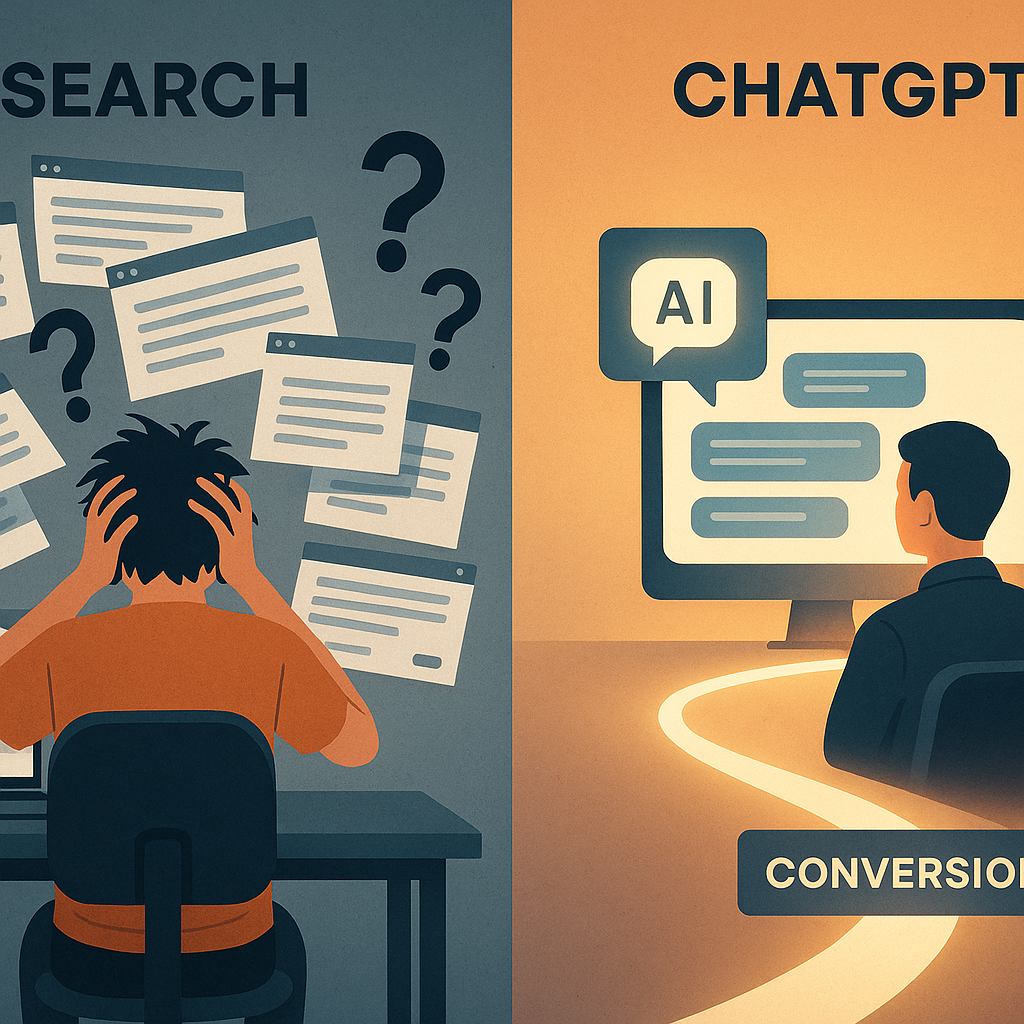
Traditional search engines operate like massive directories. A user types a query. Google returns ten blue links. The user scans, compares, clicks, backtracks, opens more tabs. It’s messy.
Search traffic is often top-of-funnel. Curious. Distracted. Half-committed.
Think about the typical journey:
- Search a question
- Open 3 - 5 tabs
- Skim each page
- Compare pricing
- Get distracted by email
- Forget what problem they were solving
It’s like walking into a crowded marketplace where everyone is shouting. Sure, there are buyers there. But there’s also noise. Endless noise.
Conversion suffers because attention fractures.
Search Traffic Is Wide - But Shallow
Traditional SEO casts a wide net. High impressions. High volume. But intent varies wildly.
Some visitors want information. Some want comparisons. Some just want quick definitions.
Few arrive fully pre-sold.
That’s the difference.
ChatGPT Traffic Comes Pre-Filtered
ChatGPT doesn’t present ten competing links. It synthesizes. It evaluates. It recommends.
When a user asks, "What’s the best tool for X?" and ChatGPT references a brand, that mention carries contextual authority. The user doesn’t feel like they’re browsing. They feel guided.
And guidance builds trust.
Instead of comparison shopping across dozens of tabs, users often click with a narrowed focus. The mental friction drops.
If search is a buffet, ChatGPT is a curated tasting menu. Less overwhelm. More direction.
AI Recommendations Create Implied Trust
Here’s a hot take: people increasingly trust AI synthesis more than ads or even blog rankings.
Why?
Because it feels neutral.
Whether that perception is perfectly accurate doesn’t matter. Perception drives behavior. When ChatGPT references a business naturally within an answer, it feels earned rather than purchased.
That psychological shift changes everything.
Why ChatGPT Traffic Converts 3x Better
Let’s break it down clearly.
1. Higher Intent From the Start
Users asking detailed questions inside ChatGPT tend to be further along in the buying cycle. They’re not just exploring a topic. They’re solving a specific problem.
Specific problem + tailored recommendation = readiness.
That equation is powerful.
2. Reduced Decision Fatigue
Traditional search creates option overload. Decision fatigue creeps in fast. The more options people evaluate, the less likely they are to act.
ChatGPT compresses the decision tree.
Fewer branches. Fewer doubts. Faster action.
3. Context-Rich Introductions
When traffic arrives from a ChatGPT mention, users often already understand:
- What the product does
- Who it’s for
- Why it was recommended
- How it compares
That context shortens the persuasion cycle dramatically.
They don’t need a long education phase. They need confirmation.
4. Authority Transfer Effect
This one is subtle but important.
When AI recommends a company, some of the perceived authority transfers. It’s similar to expert endorsements. The brand benefits from the platform’s credibility.
It’s not blind faith. It’s assisted confidence.
The SEO Shift: From Ranking Pages to Being Referenced
Traditional SEO focuses on ranking content. AI visibility focuses on being cited.
Different game. Different strategy.
Instead of optimizing purely for keywords, brands now optimize for:
- Clarity of positioning
- Topical authority
- Structured, well-organized content
- Clear value propositions
- Consistent brand signals across the web
It’s less about chasing algorithms and more about becoming unmistakably relevant.
And businesses that understand this early gain disproportionate advantage.
How Smart Brands Are Capturing ChatGPT Traffic
Forward-thinking companies don’t wait for AI traffic to happen accidentally. They design for it.
Here’s what they’re doing differently.
They Create Definitive Resources
Thin content doesn’t get cited. Surface-level blog posts don’t get referenced.
Deep, structured, authoritative resources do.
Comprehensive guides. Data-backed insights. Clear explanations. Strong formatting. Real substance.
AI systems gravitate toward clarity and depth.
They Clarify Their Unique Angle
Brands that try to appeal to everyone rarely get mentioned specifically.
Specificity wins.
For example, a company like rapidwombat.com benefits by clearly defining what it does, who it serves, and why it stands apart. The clearer the positioning, the easier it is for AI systems to associate the brand with relevant queries.
Vague brands disappear. Distinct brands surface.
They Think Beyond Clicks
Traditional SEO obsessed over traffic volume.
ChatGPT visibility prioritizes qualified visitors.
Ten highly aligned visitors can outperform a thousand random ones. That’s not theory. That’s conversion math.
Why This Trend Will Accelerate
AI-assisted search is not shrinking. It’s expanding into browsers, operating systems, and business tools.
As more users rely on conversational interfaces, recommendation-based discovery becomes normal.
And normal behavior compounds.
Consider this: when someone asks ChatGPT for "the best solution for X" and receives a structured answer, they skip multiple research steps. Convenience reshapes expectations.
Once people experience frictionless discovery, going back feels inefficient.
It’s like switching from paper maps to GPS. Nobody misses unfolding highway atlases.
But Is Traditional Search Dead?
No.
That would be dramatic. And inaccurate.
Search still drives massive discovery. It still builds awareness. It still feeds the top of the funnel.
However, the middle and bottom of the funnel are evolving fast.
ChatGPT traffic thrives in decision-heavy moments. When users want synthesis. When they want clarity. When they’re close to action.
That’s where conversion rates spike.
The Conversion Psychology Behind AI Traffic
At its core, this shift isn’t technical. It’s psychological.
People crave reduced uncertainty.
Traditional search says, "Here are your options. Good luck."
ChatGPT says, "Here’s what makes sense, and here’s why."
That difference lowers anxiety.
Lower anxiety increases commitment.
In buying decisions, emotional friction matters more than marketers admit.
Action Steps for Businesses Right Now
Brands that want to benefit from higher-converting ChatGPT traffic should focus on practical execution:
- Audit content for clarity and depth
- Strengthen topical authority in one core niche
- Use structured headings and organized formatting
- Clearly articulate differentiators
- Maintain consistent messaging across platforms
Notice what’s missing?
There’s no trick. No gimmick. No loophole.
It’s about becoming genuinely reference-worthy.
The Bottom Line
ChatGPT traffic converts better because it arrives with momentum.
Momentum built from intent. From trust. From guided discovery.
Traditional search casts wide nets across a noisy ocean. AI recommendations function more like a trusted captain pointing directly at the right dock.
Different journeys. Different energy.
Businesses that understand this shift early won’t just see better conversion rates. They’ll build stronger positioning in a discovery landscape that’s changing faster than most analytics dashboards can keep up with.
And if current patterns continue, that 3x improvement might not be the ceiling.
It could be the baseline.