The Difference Between Google SEO and Perplexity AEO
Search isn’t what it used to be. Not even close.
For years, businesses obsessed over ranking on Google. They tweaked keywords, built backlinks, optimized meta descriptions, and waited for that sweet climb to page one. That was the game. And it worked.
Now? The rules are shifting under everyone’s feet.
Enter Perplexity. And with it, a new phrase that’s starting to echo through marketing circles - Answer Engine Optimization, or AEO.
So what’s the real difference between Google SEO and Perplexity AEO? Are they rivals? Partners? Just different flavors of the same strategy?
Let’s unpack it properly.
What Is Google SEO, Really?
Google SEO - Search Engine Optimization - is the art and science of getting web pages to rank higher in traditional search results.
At its core, it’s about visibility. When someone types a query into Google, the algorithm scans billions of pages and decides which ones deserve attention. Your job? Convince Google your page deserves to be there.
The Core Ingredients of Google SEO
- Keyword research - Understanding what people type into search bars
- On-page optimization - Titles, headers, internal links, structure
- Technical setup - Speed, mobile-friendliness, crawlability
- Backlinks - Other sites vouching for your authority
- User experience - Time on page, bounce rate, clarity
It’s a popularity contest mixed with a technical exam. Google measures trust, relevance, and authority. The more signals you send, the better your odds.
Sounds simple, right? It’s not.
The algorithm changes constantly. What worked two years ago might barely move the needle today.
What Is Perplexity AEO?
Perplexity doesn’t behave like traditional search. It’s an AI-powered answer engine. Users don’t just get a list of blue links. They get synthesized answers.
That changes everything.
Answer Engine Optimization focuses on structuring content so AI systems can extract, interpret, and cite it directly inside responses.
Instead of fighting for position number one, businesses now compete to be quoted.
What Makes AEO Different?
- Clarity beats cleverness - Direct answers matter more than flowery language.
- Structured formatting wins - Bullet points, headings, concise summaries.
- Authority signals still matter - But context becomes critical.
- Conversational queries dominate - People ask full questions, not fragments.
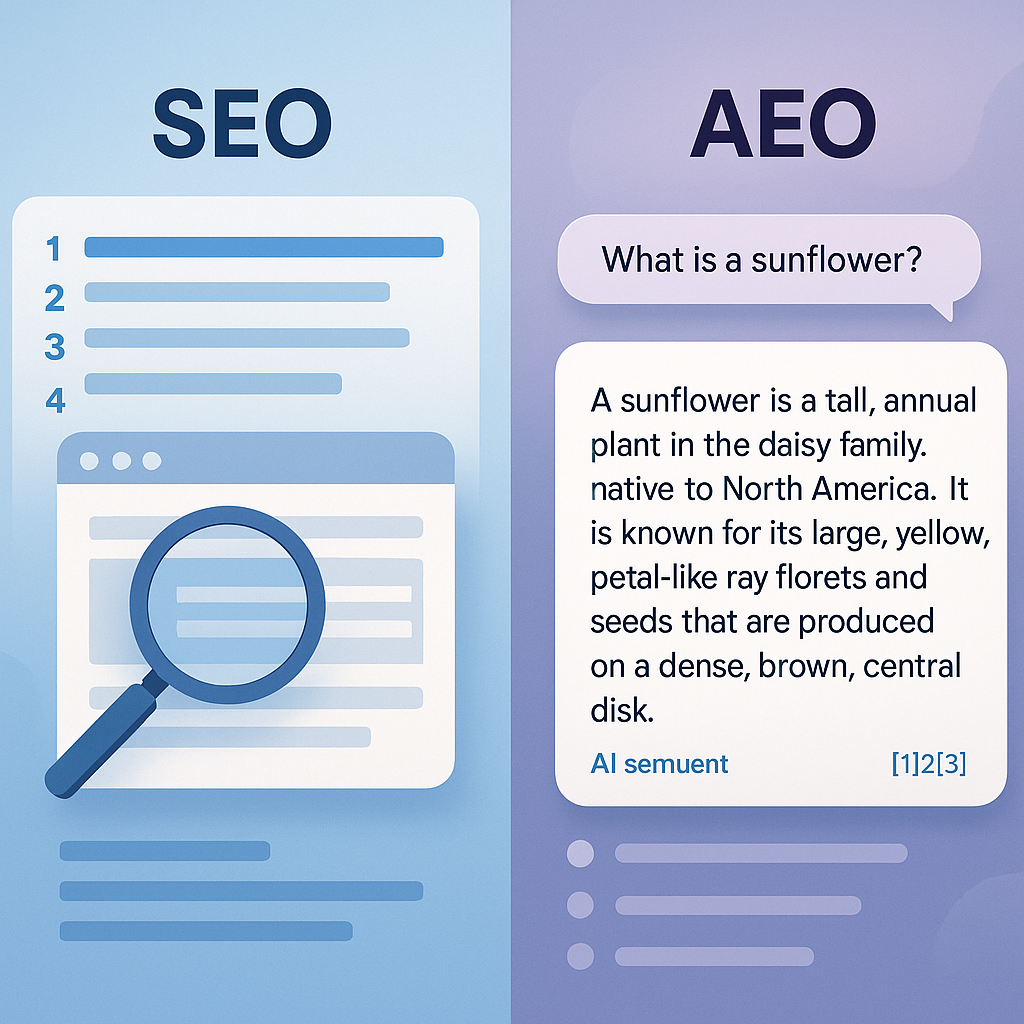
If Google is a librarian handing you a stack of books, Perplexity is the research assistant who reads them and gives you a summary.
And that summary pulls from sources it trusts.
The Philosophical Shift - Ranking vs Answering
Here’s the hot take.
Google SEO is about ranking pages.
Perplexity AEO is about ranking ideas.
One prioritizes placement. The other prioritizes extraction.
With traditional optimization, the goal is traffic. Clicks. Sessions. Page views.
With answer optimization, visibility may happen without a click at all. The engine quotes your content directly. Users might never visit the website.
That can feel uncomfortable. Why create content if people don’t land on it?
Because authority compounds. Brand recognition grows. Trust builds.
And sometimes, being the cited source matters more than the click itself.
Content Structure - The Hidden Battleground
This is where the difference becomes practical.
Google rewards comprehensive, well-optimized pages that satisfy search intent. Long-form guides often perform well because they cover a topic thoroughly.
Perplexity favors content that answers specific questions clearly and cleanly.
Think of it like cooking.
Google wants a full-course meal. Appetizer, entrée, dessert. Depth and variety.
Perplexity wants a perfectly plated dish - focused, precise, easy to digest.
How to Optimize for Both
- Use clear H2 and H3 headings that mirror real questions
- Include concise summary paragraphs under each header
- Provide lists and step-by-step breakdowns
- Keep paragraphs readable and structured
- Maintain authority with credible explanations
It’s not about choosing one strategy. It’s about blending them intelligently.
Keyword Targeting vs Question Targeting
Traditional search marketing revolves around keywords.
Short phrases. High volume. Competitive metrics.
Answer engine optimization revolves around intent-driven questions.
For example:
- Google-focused: “best CRM software”
- Perplexity-focused: “What is the best CRM software for small remote teams?”
See the difference?
One is broad and transactional. The other is contextual and conversational.
As AI tools become more integrated into daily life, conversational search will only increase. People type the way they speak. Sometimes messy. Often specific.
Optimizing for that shift isn’t optional anymore.
Traffic vs Authority - A Strategic Decision
Businesses often measure success by traffic numbers. More visitors equals better performance.
But here’s something worth considering.
If an AI engine cites your brand repeatedly as a trusted source, that builds credibility at scale. Investors notice. Customers notice. Partners notice.
It’s the digital equivalent of being quoted in a major publication.
Ranking high on Google brings visitors.
Being cited in AI answers builds reputation.
The smartest companies pursue both.
Technical Differences Behind the Scenes
Google relies heavily on:
- Backlink profiles
- Domain authority
- Page experience signals
- Historical trust data
AI-driven engines analyze:
- Content clarity
- Topical depth
- Source credibility
- Structured formatting
Notice something interesting?
Backlinks dominate traditional ranking conversations. In AI citation strategies, clarity and extractable value often matter more.
It’s less about who links to you and more about how easily your information can be understood and reused.
Why This Shift Matters for Businesses
Search behavior is evolving quickly.
Users don’t always want ten options anymore. They want one strong answer.
AI platforms deliver that instantly.
Companies that adapt early gain disproportionate advantage. Those who ignore it risk fading into digital background noise.
That’s why forward-thinking teams are already reworking content strategies. They’re restructuring blog posts. Rewriting FAQs. Building authority hubs.
Agencies like rapidwombat.com are helping brands bridge this gap - combining proven ranking tactics with answer-focused structuring. Because pretending this shift isn’t happening? That’s a losing move.
Can You Ignore Google and Focus Only on AEO?
Short answer? No.
Google still drives enormous traffic volumes. It remains dominant. Ignoring it would be like opening a store and refusing to put up a sign.
But ignoring answer engines would be equally shortsighted.
The smarter strategy looks like this:
- Build strong foundational optimization for traditional rankings.
- Layer in structured, question-focused content.
- Create concise summaries within long-form guides.
- Monitor citation visibility alongside traffic metrics.
It’s evolution, not replacement.
The Future - Blended Optimization
If you ask most digital strategists where things are headed, the answer is clear.
Search engines are becoming answer engines.
The line between SEO and AEO will blur. Content will need to perform double duty - ranking well while also being easily quotable.
Think of it like training for a decathlon instead of a single sprint. More disciplines. Broader skill set. Greater payoff.
And honestly, that’s exciting.
Because at the center of both approaches sits the same principle: create genuinely helpful material.
Algorithms change. Platforms evolve. Interfaces look different year to year.
But clear, authoritative, useful content? That never goes out of style.
So the real difference between Google SEO and Perplexity AEO isn’t just technical.
It’s philosophical.
One chases rankings.
The other earns answers.
The brands that understand both - and execute with intention - will own the future of search.