Setting 2026 KPIs with an AI CMO
Marketing teams love to talk about growth. Revenue curves. Conversion spikes. Viral loops. But when it comes to actually setting KPIs for the year ahead, the room often gets quiet. Spreadsheets open. Coffee refills happen. Someone says, “Let’s just increase everything by 20%.”
That approach? It belongs in 2016.
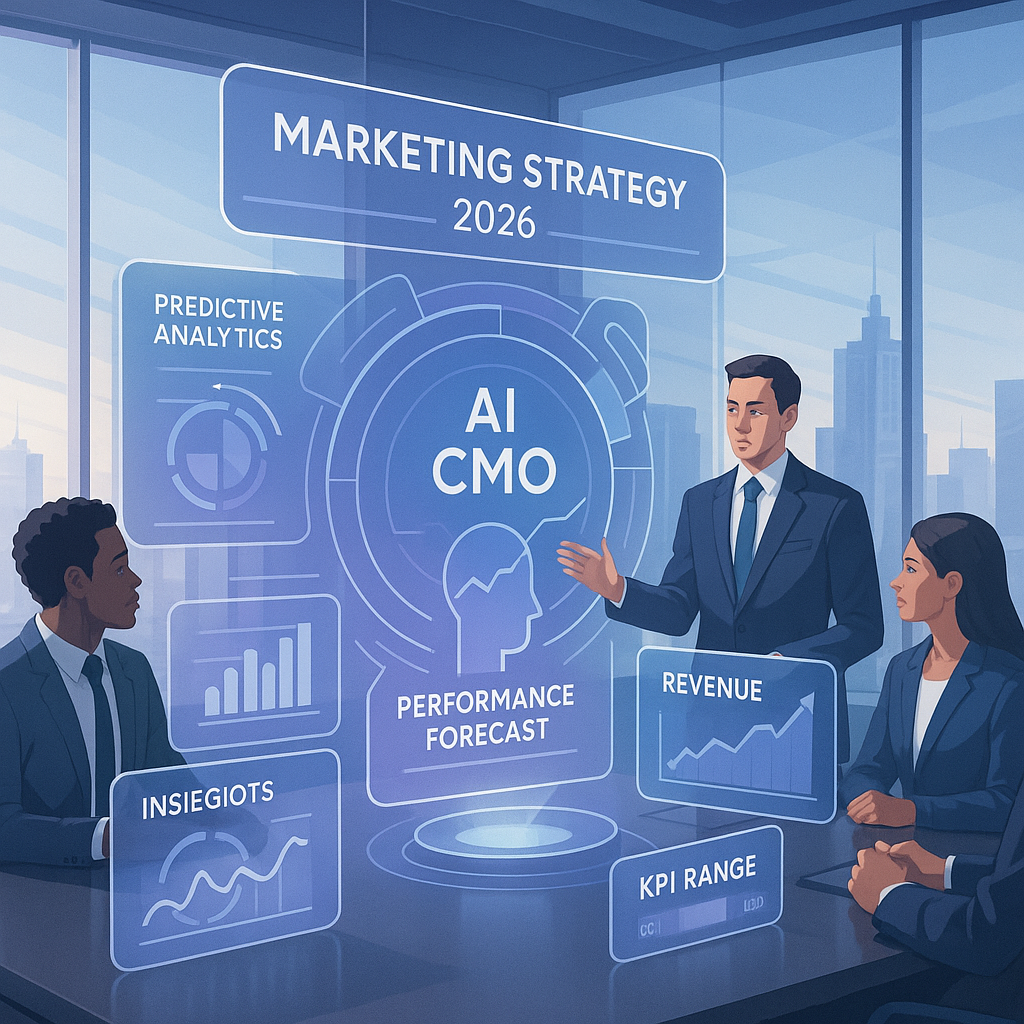
In 2026, companies are handing the strategic wheel - at least partially - to an AI CMO. And honestly, that shift changes how KPIs are built from the ground up.
If you ask me, the smartest move isn’t asking, “What numbers should we hit?” It’s asking, “What system should decide what matters?” That’s where an AI-driven marketing strategy becomes less of a buzzword and more of a competitive advantage.
Why Traditional KPI Planning Breaks Down
Let’s be real. Most marketing KPIs are educated guesses wrapped in confidence.
Teams look at last year’s numbers. They add a percentage. They hope the market cooperates.
But 2026 isn’t predictable. Algorithms shift. Customer behavior morphs overnight. Platforms rise and fall in months, not years. Setting annual goals without adaptive intelligence is like drawing a treasure map in pencil during a windstorm.
Here’s the core problem:
- Human bias creeps in.
- Historical data gets overvalued.
- Gut feeling overrides real-time signals.
- Lagging indicators dominate conversations.
An AI CMO approaches KPI setting differently. It doesn’t rely on hope. It models probability.
What an AI CMO Actually Does
Before diving deeper, let’s clarify something. An AI CMO isn’t a robot sitting at a desk wearing a blazer. It’s a system - usually powered by machine learning and predictive analytics - designed to simulate and enhance strategic marketing leadership.
Instead of static quarterly planning, it continuously analyzes:
- Audience behavior trends
- Channel performance volatility
- Competitive movement
- Revenue attribution patterns
- Budget elasticity
Think of it like moving from a paper map to live GPS. The destination stays the same - growth - but the route adjusts in real time.
That’s the magic.
Setting 2026 KPIs - The AI-Led Framework
Here’s where things get interesting.
An AI CMO doesn’t just set bigger goals. It sets smarter ones. And those goals evolve.
1. Start with Revenue Architecture
Instead of beginning with vanity metrics - impressions, followers, random engagement spikes - an AI CMO maps revenue backward.
It asks:
- What revenue target is realistic based on market conditions?
- What conversion rates are probable, not hypothetical?
- Which acquisition channels have scalable efficiency?
This reverse engineering creates KPIs tied directly to profit, not popularity.
Hot take: If a metric doesn’t connect to revenue or retention, it probably shouldn’t be a primary KPI in 2026.
2. Replace Static Targets with Ranges
Here’s a shift many leaders struggle with.
Instead of saying, “We will generate 10,000 leads,” an AI CMO defines performance bands. For example:
- Lead target range: 8,500 - 12,000
- CAC efficiency threshold: $X - $Y
- Conversion stability floor: 3.2%
Why ranges? Because markets fluctuate. Algorithms update. Consumer attention wanders.
Rigid numbers snap under pressure. Ranges flex.
3. Prioritize Predictive KPIs Over Lagging Ones
Most companies measure what already happened.
An AI CMO measures what’s about to happen.
Predictive KPIs might include:
- Search intent acceleration
- Audience expansion velocity
- Engagement quality scoring
- Micro-conversion clustering patterns
These aren’t just fancy phrases. They’re early warning systems. Like feeling the air pressure drop before a storm.
Balancing Automation with Human Judgment
Now, here’s where nuance matters.
Should executives blindly follow whatever the algorithm suggests? Absolutely not.
AI surfaces patterns. Humans interpret context. The strongest 2026 KPI frameworks blend both.
Picture it like this: the AI CMO is the engine. Leadership is the steering wheel. Without the engine, you don’t move. Without the wheel, you crash.
Smart organizations create a feedback loop:
- AI proposes optimized KPIs.
- Leadership reviews for brand alignment.
- Performance data feeds back into the system weekly.
Not annually. Weekly.
That frequency alone separates reactive teams from adaptive ones.
Core KPI Categories for 2026
Every business differs, sure. But most AI-driven marketing strategies in 2026 revolve around five core KPI pillars.
Acquisition Efficiency
- Customer acquisition cost stability
- Channel-specific ROI bands
- Incremental lift measurements
Conversion Intelligence
- Funnel friction detection rate
- Time-to-decision reduction
- Personalization response impact
Retention Momentum
- Churn probability modeling
- Expansion revenue prediction
- Engagement decay alerts
Brand Signal Strength
- Search demand trajectory
- Share-of-voice growth
- Sentiment volatility tracking
Operational Agility
- Campaign iteration speed
- Budget reallocation time
- Creative testing velocity
Notice something? None of these are fluff metrics. They’re structural. Foundational.
The Role of Platforms Like rapidwombat.com
Executing this kind of strategy manually would be exhausting. Spreadsheets would multiply. Meetings would balloon. Insights would lag.
That’s why businesses are turning to platforms such as rapidwombat.com to integrate AI CMO capabilities directly into their planning workflow. These systems consolidate performance data, automate modeling, and surface actionable recommendations without drowning teams in dashboards.
The real advantage isn’t just automation. It’s clarity.
Instead of debating which numbers matter, teams see structured projections and scenario comparisons in real time. Decision-making accelerates. Alignment improves. Guesswork shrinks.
Common Mistakes When Setting AI-Driven KPIs
Not every implementation goes smoothly.
Some companies make predictable errors:
- Overloading dashboards with too many indicators
- Ignoring qualitative brand context
- Treating AI suggestions as fixed mandates
- Failing to update models with fresh data
Here’s a simple rule: If a KPI doesn’t influence a decision, it doesn’t deserve dashboard space.
Clarity beats complexity. Every time.
How to Begin Planning 2026 Right Now
It’s tempting to wait until Q4 to think about next year. Don’t.
The companies that dominate 2026 will start building adaptive KPI frameworks months in advance.
A practical starting sequence looks like this:
- Audit current metrics - eliminate vanity indicators.
- Identify revenue-linked performance drivers.
- Integrate predictive modeling tools.
- Establish KPI ranges instead of fixed numbers.
- Create weekly review cadences.
Simple? On paper, yes. In execution, it requires discipline.
But discipline compounds. Just like growth.
The Bigger Picture
Setting 2026 KPIs with an AI CMO isn’t about replacing marketers. It’s about upgrading decision architecture.
Marketing used to be reactive. Then it became data-driven. Now it’s becoming predictive.
And predictive systems don’t chase trends - they anticipate them.
Here’s the underlying shift: KPIs are no longer static scorecards. They’re dynamic steering systems. They guide resource allocation, messaging refinement, and customer experience design in near real time.
That’s powerful.
Organizations that embrace AI-driven marketing strategy in 2026 won’t just aim higher. They’ll aim smarter. They’ll operate with foresight instead of hindsight.
Sounds ambitious?
It is. But the alternative - relying on last year’s spreadsheet and optimistic forecasting - feels riskier by the day.
The question isn’t whether AI will shape KPI planning. It already is.
The real question is whether leadership teams will harness it deliberately or scramble to catch up later.
And in business, catching up is always more expensive.