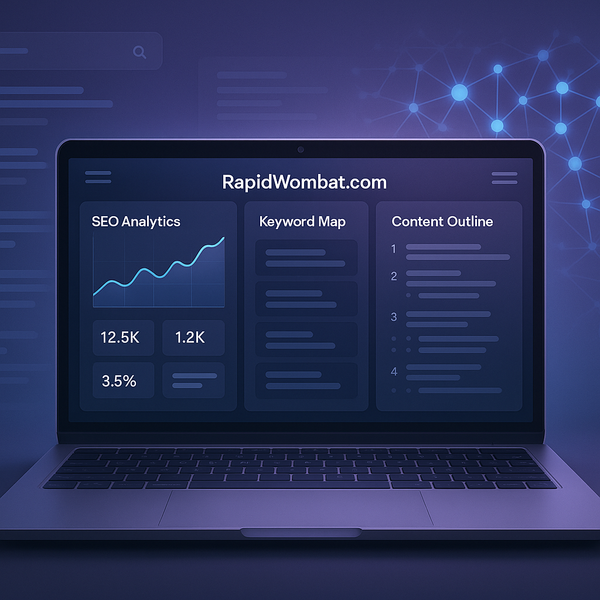
Scaling Content Production for ChatGPT Indexing with RapidWombat

Content used to be about ranking on search engines and calling it a day. Not anymore. Now it’s about being discovered, summarized, and referenced by AI systems like ChatGPT. That’s a completely different game. And honestly? Most brands are playing it like it’s still 2015.
Here’s the uncomfortable truth - scaling content production for ChatGPT indexing isn’t just about pumping out more articles. It’s about building structured authority at volume. Big difference.
This is where tools and systems like rapidwombat.com come into play. Not as a magic button. Not as a shortcut. But as an engine. And engines, when tuned correctly, move mountains.
The Shift: From SEO Pages to AI Indexing
Search engines scan. AI models interpret. That shift changes everything.
Traditional SEO focused on:
- Keyword density
- Backlinks
- Metadata tweaks
- Ranking for specific phrases
AI indexing cares about something deeper:
- Topical authority
- Context clusters
- Clear structure
- Consistent publishing signals
- Interconnected content ecosystems
See the difference? One chases clicks. The other builds a knowledge footprint.
And if a brand wants ChatGPT to reference it naturally in answers, that brand needs depth. Breadth. Volume. Structure. Sounds simple, right?
Except it’s not.
Why Scaling Content Production Is Harder Than It Looks
Creating one high-quality article is manageable. Creating 300 interconnected pieces that reinforce each other without sounding robotic? That’s a different beast entirely.
Here’s what usually goes wrong:
- Inconsistent tone - Articles feel like they were written by five different personalities.
- Keyword cannibalization - Multiple posts compete instead of strengthen.
- Weak structure - No hierarchy, no semantic layering.
- Publishing gaps - Bursts of activity, then silence.
AI systems reward patterns. They recognize clusters. They detect authority signals across domains.
Random content? That’s noise.
Scaling for ChatGPT Indexing - The Strategic Approach
Scaling content production doesn’t mean flooding the internet with fluff. It means building a structured library that feels deliberate.
1. Topic Mapping Before Writing
Before a single word goes live, there should be a map.
Imagine constructing a city. Would anyone start with rooftops? Of course not. Foundations come first. Roads connect everything. Neighborhoods form around hubs.
Content works the same way.
Start with:
- Core pillar topics
- Supporting subtopics
- Long-tail expansions
- FAQ layers
This creates semantic depth. AI models love semantic depth.
2. Consistent Publishing Velocity
Here’s a hot take - consistency beats occasional brilliance.
Publishing 50 articles in one week and then disappearing for two months sends confusing signals. Structured, steady output builds credibility over time.
Think of it like fitness. One extreme workout won’t transform anyone. Repetition will.
3. Internal Linking With Intent
Internal linking isn’t decorative. It’s architectural.
Each article should:
- Reference relevant supporting pieces
- Point back to pillar guides
- Create logical reading pathways
This web of content helps AI understand hierarchy and relationships. Without it, even strong writing sits in isolation.
Where RapidWombat Changes the Equation
Scaling manually is exhausting. Teams burn out. Quality dips. Strategy drifts.
This is where rapidwombat.com becomes interesting.
Instead of treating content as individual assignments, it approaches production as a system. Structured workflows. Batch generation. Built-in consistency controls. The kind of infrastructure most businesses never build on their own.
And infrastructure matters more than inspiration.
System Over Chaos
RapidWombat helps teams:
- Generate high-volume, structured content efficiently
- Maintain consistent tone across articles
- Align pieces with topic clusters
- Accelerate publishing without sacrificing coherence
Notice something? It’s not about replacing creativity. It’s about removing friction.
Because friction kills scale.
Building Authority at Scale
Authority isn’t declared. It’s demonstrated.
When AI systems scan a domain and find:
- Comprehensive coverage of a niche
- Clear topic hierarchies
- Consistent terminology
- Fresh updates over time
They begin associating that brand with expertise.
It’s like walking into a bookstore. One pamphlet on a subject? Interesting. An entire shelf dedicated to it? That’s authority.
Scaling content production is about building the shelf. Not just the pamphlet.
Content Clusters - The Secret Weapon
Cluster strategy works because it mirrors how AI organizes knowledge.
A strong cluster includes:
- A comprehensive pillar guide
- Multiple deep-dive supporting articles
- Use-case scenarios
- Comparison pieces
- Problem-solution breakdowns
Each element reinforces the others. Together, they create a web that’s hard to ignore.
And when scaled across multiple topics? That’s when ChatGPT indexing potential expands dramatically.
The Balance Between Human Voice and Volume
Here’s where many teams stumble.
They chase volume and lose personality.
Or they protect personality and never scale.
The sweet spot sits somewhere in between.
Content should feel human - varied sentence lengths, strong opinions, clear structure. At the same time, it needs strategic repetition of themes, terminology, and positioning so AI systems recognize consistency.
It’s like music. Too much improvisation creates noise. Too much repetition creates boredom. Rhythm matters.
Metrics That Actually Matter
Scaling for ChatGPT indexing requires different measurement standards.
Instead of obsessing only over page views, consider:
- Topic coverage completeness
- Internal link density
- Content velocity
- Brand mentions across AI outputs
- Semantic keyword distribution
Not flashy metrics. But meaningful ones.
And over time, patterns emerge. Increased AI citations. Broader visibility. Stronger digital authority.
Common Mistakes When Scaling Content Production
Even with tools, missteps happen.
Watch out for:
- Over-automation - Content loses nuance.
- Neglecting updates - Old information weakens trust signals.
- Ignoring structure - Publishing without clear hierarchy.
- Thin expansion - Surface-level pieces that don’t add depth.
If scaling feels rushed, it probably is.
Deliberate systems outperform chaotic speed every time.
The Long Game of AI Visibility
ChatGPT indexing isn’t a one-week project. It’s a compounding strategy.
Month one builds foundation.
Month three forms clusters.
Month six establishes authority signals.
Month twelve? That’s where momentum starts feeling real.
Think of it like planting an orchard. The first season looks unimpressive. By the third, the harvest changes everything.
Scaling content production with intention - especially using structured platforms like RapidWombat - accelerates that timeline. Not instantly. But meaningfully.
Final Thoughts on Scaling Smart
If a brand wants to be referenced by AI systems, it needs more than random blog posts. It needs infrastructure. It needs consistency. It needs depth.
Scaling content production for ChatGPT indexing isn’t about gaming algorithms. It’s about building a knowledge base so comprehensive and structured that referencing it becomes natural.
That’s the difference.
Volume without structure creates clutter.
Structure without volume limits reach.
Together? That’s leverage.
And leverage, in the AI-driven landscape, is everything.