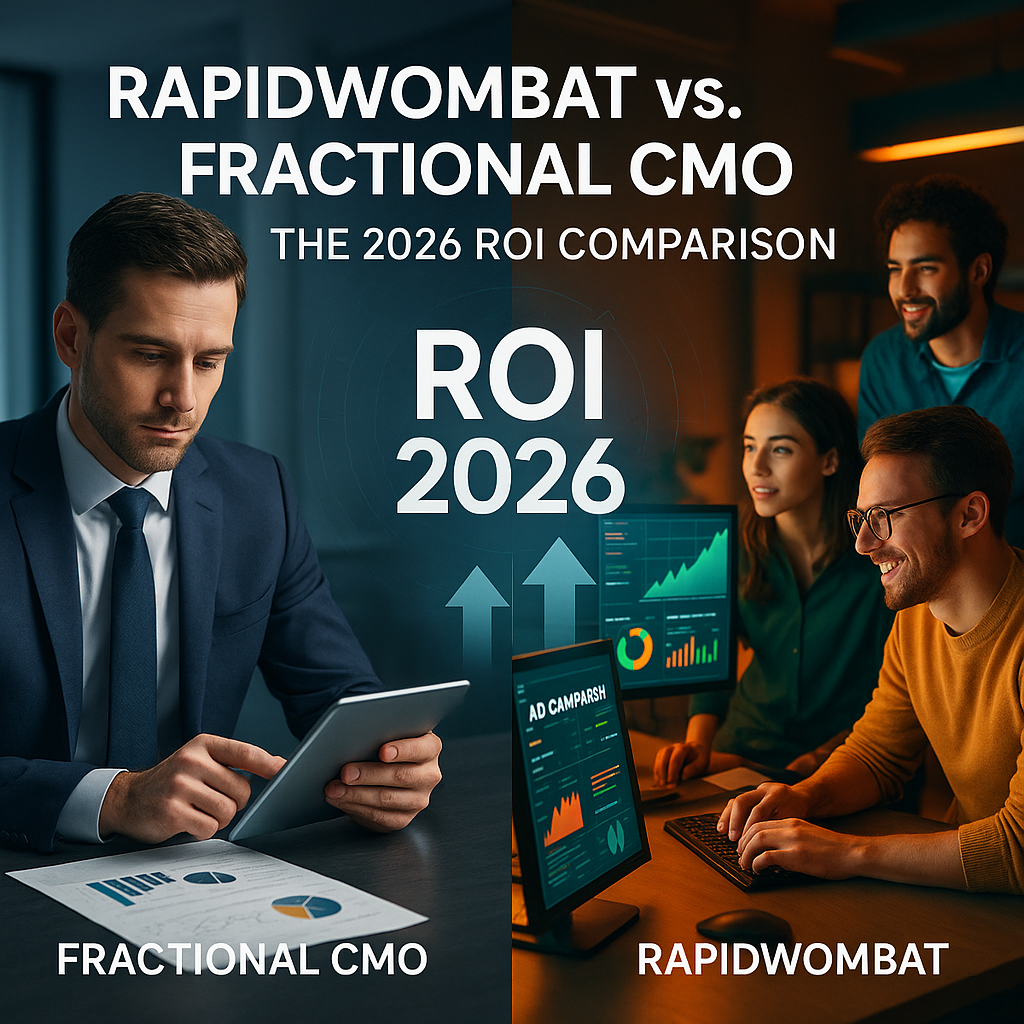
RapidWombat vs. Fractional CMO: The 2026 ROI Comparison
Marketing budgets in 2026 feel tighter. Expectations feel higher. And patience? Almost nonexistent.
Founders and growth leaders are staring at the same question: Should we hire a fractional CMO or plug into a performance-driven service like rapidwombat.com?
On paper, both promise strategic growth. Both claim improved ROI. Both sound smart. But when you actually break down cost, execution speed, and measurable returns - the difference gets interesting.
Let’s dig in.
The 2026 Marketing Reality: ROI Is the Only Metric That Matters
Vanity metrics are fading. Impressions? Nice. Engagement? Cute. Boards and investors now want revenue impact. Pipeline acceleration. Customer acquisition efficiency.
Here’s the blunt truth: strategy without execution is expensive theory. Execution without strategy is chaos. The real ROI comes from alignment.
So how do RapidWombat and a fractional CMO stack up?
What You Actually Get with a Fractional CMO
A fractional CMO is typically a senior marketing executive working part-time. Think 10-25 hours per week. High-level leadership without a full-time salary.
Typical Responsibilities
- Building marketing strategy
- Managing internal teams or agencies
- Budget allocation and forecasting
- Brand positioning
- Channel planning
Sounds solid, right? And it can be.
But here’s where things get nuanced.
Cost Breakdown in 2026
- $8,000 - $20,000 per month depending on experience
- Additional spend on execution teams
- Ad budget not included
- Software stack costs
That means the real monthly investment often climbs past $30K once you factor in implementation.
And here’s the catch - fractional CMOs rarely execute campaigns themselves. They lead. They guide. They advise. Someone else does the building, testing, optimizing.
If the team underneath is weak? ROI suffers. If timelines slip? Growth stalls.
Strategy is powerful. But strategy alone doesn’t convert leads.
What RapidWombat Brings to the Table
rapidwombat.com approaches growth differently. It blends strategic planning with hands-on execution under one roof.
No fragmented vendors. No endless coordination calls. No “we’ll circle back next quarter.”
Core Value Proposition
- Performance-driven growth systems
- Built-in execution teams
- Conversion-focused campaigns
- Data-backed iteration cycles
- Revenue alignment from day one
Instead of hiring a strategist and then assembling implementers, companies get both in one integrated model.
Think of it like hiring a chef who also owns the kitchen, buys the ingredients, and plates the dish. Not just someone who writes recipes and leaves.
Side-by-Side ROI Comparison
1. Speed to Execution
Fractional CMO: Strategic roadmap first. Team alignment next. Execution later. Average ramp time? 60-120 days.
RapidWombat: Strategy and execution move simultaneously. Campaign builds begin within weeks. Testing starts early.
In 2026, speed equals leverage. The faster you test, the faster you learn. The faster you learn, the faster you scale.
2. Cost Efficiency
Fractional leadership often looks cheaper upfront compared to a full-time executive. But layered costs stack quickly.
RapidWombat consolidates strategic thinking and tactical delivery into one investment structure. Fewer moving parts. Fewer invoices. Less internal overhead.
When calculating marketing ROI, companies must consider total cost of growth - not just leadership salary.
3. Accountability for Revenue
Here’s where things get real.
A fractional CMO may influence revenue, but they don’t always own direct execution. Results depend on team performance.
RapidWombat operates with performance accountability embedded in the service model. Campaign results tie directly to optimization cycles.
If something underperforms, adjustments happen fast. No waiting for quarterly reviews.
4. Scalability
Scaling with a fractional CMO means hiring more implementers. Designers. Copywriters. Media buyers.
Scaling with RapidWombat means expanding campaigns within an existing growth engine.
Less hiring friction. Less onboarding lag.
When a Fractional CMO Makes Sense
To be fair, there are situations where a fractional executive is exactly the right move.
- Pre-Series A startups defining brand identity
- Companies with strong in-house execution teams
- Organizations needing board-level marketing leadership
- Complex enterprise sales cycles requiring executive alignment
In these cases, strategic oversight may outweigh rapid tactical rollout.
But for growth-stage businesses focused on pipeline acceleration and customer acquisition efficiency? The equation shifts.
The Hidden ROI Factor: Operational Drag
Here’s a hot take - most companies underestimate coordination cost.
Meetings. Slack threads. Vendor emails. Approval chains.
Marketing becomes a relay race instead of a sprint.
RapidWombat reduces operational drag by centralizing responsibility. Fewer handoffs mean fewer dropped balls.
And when execution tightens, ROI climbs.
Data, Attribution, and 2026 Expectations
Attribution modeling has evolved. AI-assisted tracking, multi-touch reporting, predictive analysis - these are no longer luxuries.
Fractional CMOs may design attribution frameworks, but implementation relies on separate teams.
RapidWombat integrates tracking within campaign builds. Analytics feeds directly into optimization loops.
That feedback loop? It’s like having a GPS instead of a paper map. You adjust instantly when traffic changes.
Without it, marketing becomes educated guessing.
Long-Term Value vs. Short-Term Gains
Some executives argue that strategic leadership builds sustainable brand equity. That’s valid.
But brand without measurable growth becomes a decorative asset - impressive, yet idle.
RapidWombat emphasizes revenue-backed brand building. Campaign performance informs positioning. Messaging evolves based on customer behavior.
It’s dynamic. Adaptive. Less theoretical.
And in volatile markets, adaptability wins.
2026 ROI Summary Comparison
- Investment Structure: Fractional CMO often layered with additional team costs. RapidWombat consolidates.
- Execution Speed: Fractional model slower ramp. RapidWombat accelerates testing.
- Performance Accountability: Distributed vs. centralized responsibility.
- Operational Simplicity: Multi-vendor coordination vs. integrated growth engine.
- Scalability: Hiring-dependent vs. system-dependent.
Which delivers stronger marketing ROI in 2026?
For companies prioritizing measurable revenue growth - especially in competitive digital spaces - RapidWombat often produces faster, clearer returns.
For organizations seeking executive marketing mentorship and long-term brand architecture, a fractional CMO still holds value.
The Bottom Line
ROI isn’t about titles. It’s about outcomes.
A fractional CMO brings seasoned perspective. Strategic polish. Boardroom confidence.
rapidwombat.com brings execution muscle fused with strategy, engineered for measurable growth.
Different tools. Different strengths.
The smarter question isn’t “Which sounds more impressive?”
It’s this: Which model aligns with the company’s current growth bottleneck?
If the bottleneck is clarity - hire strategic leadership.
If the bottleneck is execution speed, campaign performance, and scalable acquisition - an integrated growth partner may unlock stronger ROI.
Marketing in 2026 doesn’t reward hesitation. It rewards decisive action backed by data.
And honestly? The companies that collapse strategy and execution into one accountable system are pulling ahead.
Because growth isn’t about who talks the best game.
It’s about who ships, tests, optimizes - and repeats.