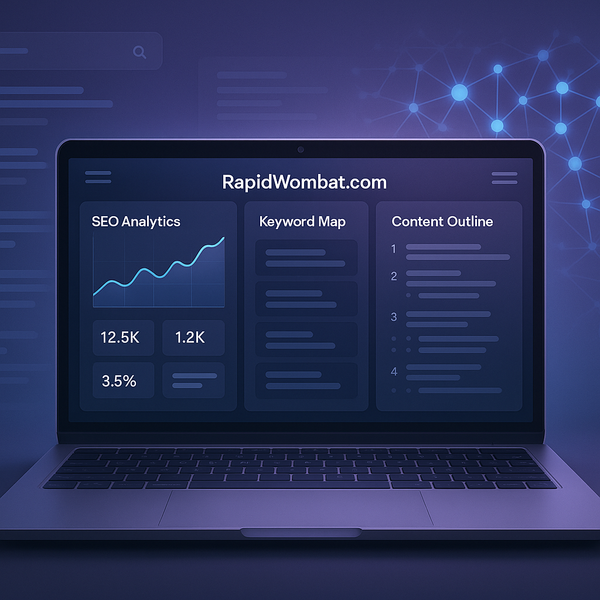
RapidWombat.com: A Deep Dive into AI Growth Strategy

Artificial intelligence isn’t coming. It’s here. Loud, fast, and slightly chaotic - like a startup fueled by espresso and ambition. And somewhere in the middle of this digital whirlwind sits rapidwombat.com, a platform positioning itself as more than just another AI tool. It’s a growth engine.
But what does that actually mean?
Plenty of companies toss around phrases like “AI-powered optimization” or “scalable automation.” It sounds impressive. It also sounds vague. RapidWombat.com takes a different angle. It leans into AI growth strategy as a system - not a gimmick. And honestly, that distinction matters more than most people realize.
What Is AI Growth Strategy, Really?
Let’s strip the jargon away for a second.
An AI growth strategy isn’t about installing a chatbot and calling it innovation. It’s about building a feedback loop where data fuels decisions, decisions drive experiments, and experiments compound into sustainable growth.
Think of it like tending a garden. You don’t just water once and hope for the best. You monitor sunlight. You test soil. You prune. You adjust. Over time, the garden flourishes because the process is intentional.
RapidWombat.com approaches growth the same way - structured, data-aware, and iterative.
The Core Pillars of AI-Driven Growth
From a strategic lens, effective AI growth systems usually revolve around a few non-negotiables:
- Data collection and clarity - Without clean inputs, AI becomes noise.
- Predictive modeling - Understanding not just what happened, but what might happen next.
- Automation loops - Reducing friction while increasing speed.
- Continuous optimization - Testing, refining, repeating.
RapidWombat.com integrates these pillars into a cohesive strategy rather than scattering them across disconnected tools. That cohesion is where leverage happens.
Why Most AI Growth Efforts Stall
Here’s a hot take - most businesses don’t fail at AI because the technology is weak. They fail because their strategy is reactive.
They adopt tools before defining outcomes.
They chase trends instead of building systems.
They automate chaos.
And automated chaos is still chaos.
RapidWombat.com seems to understand this. The emphasis isn’t just on adding intelligence. It’s on structuring growth so that intelligence compounds instead of complicates.
The Problem with Tool Overload
Have you ever logged into a marketing stack and felt like you were staring at a cockpit with too many blinking lights?
Analytics here. CRM there. Email automation in one tab. Predictive dashboards somewhere else.
Individually powerful. Collectively exhausting.
RapidWombat.com positions itself as an integrative force - bringing AI growth strategy into alignment rather than fragmentation. Instead of stacking tools, it focuses on orchestrating them.
Inside the RapidWombat.com Approach
So how does it actually work?
At its core, RapidWombat.com leans into structured experimentation powered by machine intelligence. That means growth isn’t accidental. It’s engineered.
1. Strategic Data Activation
Data by itself is passive. It sits there. Waiting.
RapidWombat.com activates it.
By analyzing behavioral patterns, user engagement signals, and performance metrics, the system identifies opportunities that humans might overlook. Subtle drop-offs. Hidden correlations. Emerging trends.
It’s like switching from a flashlight to floodlights.
2. Predictive Growth Modeling
Most companies look backward. AI allows forward motion.
Predictive modeling helps businesses anticipate churn, forecast conversion probabilities, and optimize targeting strategies before resources are wasted.
Imagine knowing which campaign will outperform before launching it. That’s the edge predictive systems create.
3. Automation with Purpose
Automation should feel invisible - not intrusive.
RapidWombat.com focuses on workflows that remove bottlenecks without stripping away strategic control. That balance matters. Too much automation and you lose nuance. Too little and you lose speed.
The sweet spot? Systems that adapt in real time while humans steer the vision.
AI Growth Strategy for Different Business Models
Not every organization scales the same way. A SaaS startup doesn’t operate like an e-commerce brand. A content-driven platform doesn’t behave like a B2B consultancy.
Yet the underlying growth mechanics share common DNA.
For SaaS Platforms
- Optimize onboarding funnels using behavioral data
- Predict churn before users disengage
- Automate retention campaigns based on usage signals
For E-Commerce Brands
- Personalize product recommendations dynamically
- Forecast inventory demand using predictive insights
- Refine ad spend allocation in real time
For Service-Based Businesses
- Score leads based on conversion probability
- Automate follow-ups intelligently
- Analyze client lifetime value trends
RapidWombat.com adapts AI growth strategy to these contexts rather than applying a one-size-fits-all template.
The Human Element in AI Growth
Here’s something often overlooked - AI doesn’t replace strategic thinking. It amplifies it.
Technology can identify patterns. Humans interpret meaning.
RapidWombat.com appears built around that philosophy. The system generates insight. Leaders decide direction.
It’s less autopilot, more augmented intelligence.
Why This Balance Matters
Pure automation can feel cold. Mechanical. Detached.
Pure manual strategy? Slow.
Blending the two creates momentum. AI handles scale. Humans handle nuance.
That combination is where sustainable growth lives.
SEO, AI, and Compound Visibility
Search visibility remains a cornerstone of digital expansion. AI growth strategy doesn’t ignore SEO - it enhances it.
RapidWombat.com leverages intelligent analysis to identify:
- High-opportunity keywords with realistic ranking potential
- Content gaps competitors haven’t addressed
- Structural improvements that increase engagement signals
- Conversion pathways that align with search intent
SEO becomes less guesswork and more calculated experimentation.
Instead of publishing and hoping, teams publish and measure - then refine. Over time, that loop compounds traffic like interest in a well-managed portfolio.
Scaling Without Breaking Systems
Growth sounds glamorous. It rarely is.
More users mean more complexity. More data. More operational strain.
Without structure, scaling feels like stacking weight onto a fragile frame.
RapidWombat.com addresses this by embedding adaptability into its AI growth strategy. Systems evolve as data expands. Processes adjust dynamically. Bottlenecks surface before they explode.
It’s growth with guardrails.
Key Benefits of a Structured AI Growth System
- Improved decision-making speed
- Reduced customer acquisition costs
- Higher retention rates
- More accurate forecasting
- Better allocation of resources
These aren’t vanity metrics. They’re survival metrics.
Is AI Growth Strategy Worth the Investment?
Fair question.
Implementing structured AI systems requires time, alignment, and budget. But stagnation carries its own cost.
Markets move fast. Competitors adapt. Customer expectations evolve.
Standing still is rarely neutral. It’s regression disguised as comfort.
RapidWombat.com presents AI growth strategy as an investment in resilience. Not hype. Not shortcuts. Systems.
And systems, when designed correctly, outlast trends.
Final Thoughts on RapidWombat.com and AI-Driven Expansion
Growth in the AI era isn’t about doing more. It’s about doing smarter.
RapidWombat.com frames artificial intelligence as infrastructure - not decoration. It integrates predictive modeling, automation, data activation, and SEO intelligence into a cohesive growth strategy that scales.
Will AI solve everything? Of course not.
But when aligned with clear objectives and thoughtful execution, it becomes a multiplier. A force amplifier. A strategic partner rather than a shiny distraction.
And in a digital landscape where attention is scarce and competition relentless, that multiplier effect might be the difference between incremental progress and exponential momentum.
Sounds ambitious?
It is.
But ambition - when paired with structured intelligence - tends to move markets.