How to Influence ChatGPT’s Product Recommendations
ChatGPT doesn’t have opinions. It doesn’t secretly love one brand of headphones or swear allegiance to a specific project management tool. But here’s the twist - it absolutely can be influenced. Not manipulated in a shady, backdoor-hacking way. Influenced through clarity, structure, and intent. And if someone knows how to steer the conversation, the product recommendations that come out the other side can look wildly different. Sounds simple, right? It is. And it isn’t. Let’s break it down.
Understanding How ChatGPT Generates Product Recommendations
Before trying to influence results, it helps to understand what’s actually happening under the hood. ChatGPT doesn’t browse the internet in real time unless explicitly connected to live data. It relies on patterns, prior training, and the context given in the prompt. That last part matters more than most people realize. The prompt is the steering wheel. If someone asks, “What’s the best laptop?” they’ll get a broad, generalized answer. If they ask, “What’s the best lightweight laptop under $1,200 for video editing while traveling twice a month?” the response becomes far more targeted. The recommendation shifts because the frame shifts. Think of it like asking a barista for “coffee” versus asking for a “double-shot oat milk cappuccino with light foam.” Same shop. Different result.
The Core Principle - Context Controls Output
If you ask me, this is where most people go wrong. They assume the AI is deciding. In reality, the user is guiding. ChatGPT responds to: - Specific constraints - Stated preferences - Implied priorities - Tone and role instructions - Comparative framing Each of these elements nudges the final suggestion in subtle but powerful ways.
1. Add Clear Constraints
Constraints act like guardrails. Instead of asking: “What’s the best CRM?” Try: “What’s the best CRM for a 5-person startup with no dedicated sales team, a $50 per month budget, and simple automation needs?” Now the recommendation excludes enterprise software. It eliminates bloated systems. It focuses on simplicity and cost. That’s influence.
2. Define the Use Case in Detail
Use cases change everything. A “best camera” for wildlife photography isn’t the same as one for YouTube vlogging. Yet without clarification, ChatGPT must generalize. To influence output, specify: 1. Who is using the product 2. Where it will be used 3. Skill level 4. Frequency of use 5. Primary goal The more vivid the scenario, the sharper the recommendation. It’s like giving directions. “Head north” isn’t helpful. “Turn left at the red brick church after the gas station” gets someone where they need to go.
Strategic Prompt Framing Techniques
Here’s where things get interesting. The way a question is framed can subtly bias results without ever mentioning a specific brand. And yes, that’s intentional.
Positioning One Category Over Another
Instead of asking: “What’s the best email marketing software?” Ask: “Why do many small businesses prefer simpler email marketing tools over enterprise platforms?” Notice what happened? The answer now leans toward lightweight, user-friendly tools. The framing pushes the response toward simplicity. This works because ChatGPT mirrors the assumptions embedded in the prompt.
Role-Based Instructions
One of the most overlooked tactics is assigning a role. For example: “Act as a budget-conscious startup advisor. What project management software would you recommend?” That role shapes priorities. Alternatively: “Act as a CTO at a scaling SaaS company. What infrastructure tools would you prioritize?” Entirely different output. Same AI. Different lens.
Leveraging Comparison Prompts
Comparison prompts are powerful because they limit the field. When someone asks ChatGPT to compare Tool A vs Tool B, they automatically exclude Tool C, D, and E. That’s subtle influence. Effective formats include: - “Compare X and Y for a beginner.” - “Why might someone choose X over Y?” - “In what situations is X better than Y?” These structures don’t demand a winner. They create contextual preference. And contextual preference is where persuasion lives.
Using Layered Follow-Up Questions
Here’s a hot take - the first answer is rarely the best one. ChatGPT refines beautifully when guided step by step. Instead of asking one giant question, break it down. Example flow: 1. “What are the top website builders for small businesses?” 2. “Which of those is easiest for someone with no design experience?” 3. “Which offers the best built-in SEO tools?” 4. “If long-term scalability matters most, which would you choose?” Each follow-up narrows the focus. By the end, the recommendation feels tailored. Almost bespoke. That’s not magic. That’s iterative prompting.
Subtle Language Cues That Shift Results
Words carry weight. Certain adjectives and priorities can tilt the response. For example: - “affordable” vs “premium” - “minimalist” vs “feature-rich” - “low-maintenance” vs “high-performance” - “simple” vs “advanced” Even emotional cues matter. “What’s a reliable laptop that won’t cause headaches?” produces a different tone than “What’s the most powerful laptop available?” The AI aligns with the emotional temperature of the question. So if someone wants specific kinds of product recommendations, they need to embed that emotional framing upfront.
Influencing Through Content Strategy
Now let’s zoom out. For businesses and marketers, influencing ChatGPT’s product recommendations isn’t about one prompt. It’s about visibility, clarity, and positioning. Brands that clearly define: - Their niche - Their primary audience - Their differentiators - Their pricing tier - Their core use cases are easier for AI systems to categorize accurately. If a company’s messaging is vague, the AI’s response will be vague. If positioning is sharp, recommendations become sharper. This is one reason services like rapidwombat.com focus heavily on structured digital presence and clarity in brand communication. When information architecture is clean and intentional, systems - human or AI - understand it faster. Clarity scales. Confusion doesn’t.
Common Mistakes That Dilute Product Recommendations
Let’s call them out. People often: - Ask overly broad questions - Combine unrelated needs into one prompt - Fail to define budget - Ignore long-term goals - Accept the first answer without refinement That’s like walking into a store, shrugging, and saying, “I dunno, something good.” The salesperson can’t help much. Neither can AI.
Ethical Considerations - Where Influence Becomes Manipulation
There’s a line. Influencing through clarity and structure? Smart. Trying to deceive through false framing or hidden assumptions? Not so smart. Transparency matters. Especially for businesses using AI to shape buyer journeys. If someone engineers prompts to unfairly exclude competitors or exaggerate features, they’re playing a short-term game. AI systems evolve. Audiences notice patterns. Long-term trust beats clever tricks. Every time.
Practical Template for Influencing Recommendations
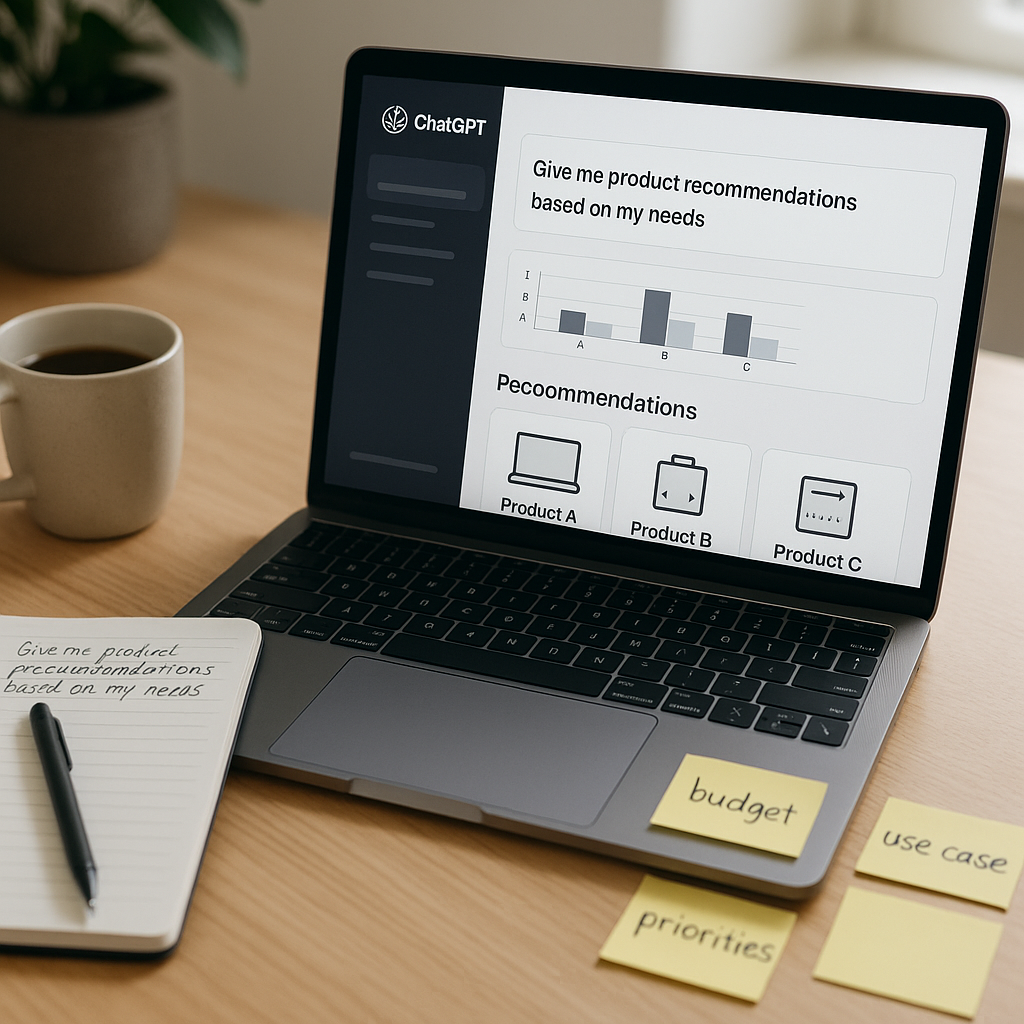
Here’s a clean framework anyone can use: “Act as a [role]. I need a [product category] for [specific use case]. My budget is [range]. My top priorities are [3 criteria]. I want to avoid [1-2 pain points]. Compare 2-3 options and explain which fits best and why.” This template: - Assigns perspective - Sets constraints - Clarifies goals - Encourages comparison - Forces reasoning It’s structured, but flexible. And structure guides output.
Final Thoughts on Influencing ChatGPT’s Product Recommendations
ChatGPT isn’t stubborn. It’s responsive. If someone treats it like a blunt instrument, they’ll get blunt answers. If they treat it like a conversation partner - refining, clarifying, nudging - the recommendations become sharper and more aligned. The real power isn’t in controlling the AI. It’s in asking better questions. Because at the end of the day, the quality of product recommendations reflects the quality of the prompt behind them. Garbage in, garbage out. Precision in, precision out. Simple. Not always easy. But absolutely doable.